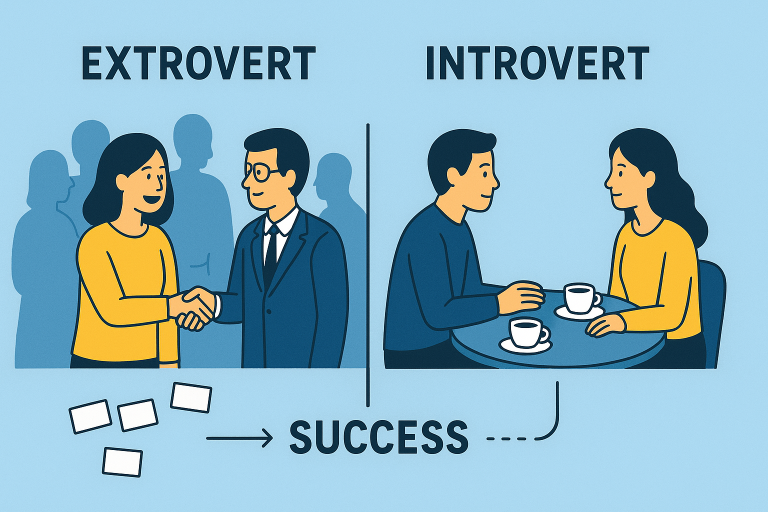
Are you desperate to send out dozens of applications but hearing nothing back? You might be competing in the wrong arena. Studies and hiring managers consistently report that 70% to 80% of jobs are never publicly posted. This vast landscape of unadvertised opportunities is known as The Hidden Job Market. These roles are filled through networks, referrals, and direct outreach long before they publish in a public listing.

Research from LinkedIn's recruiting research shows that 70% of successful hires come from within networks, not public job boards. Candidates from the hidden market are 3x more likely to get offers and 2x more likely to accept and stay. Why? Less competition. Better fit assessment. Personal recommendation carries weight.
I spent 3 months applying to public job boards. Nothing. Literally nothing. Then a friend mentioned his company was hiring. I talked to him for 20 minutes. He introduced me to the hiring manager. Two interviews later, I had offer. Three months of public applications vs. 2 weeks through network. The hidden market is where the real jobs are, says product manager Jamal Washington.
Accessing and mastering this market helps you to submit your resume as a trusted, referred candidate with significantly less competition.
What Is the Hidden Job Market?
The Hidden Job Market refers to all job openings that are filled without ever being advertised on public platforms like company career pages, LinkedIn Jobs, or Indeed.
These opportunities are available for job seekers who build proactive relationships or use strategic search methods.
Instead of a formal "apply now" button, these jobs are secured through:
- Conversations,
- Internal recommendations,
- And direct partnerships with recruiters.
The Hidden Job Market is valuable for employers because it is built on trust and referrals, rather than a perfect resume from a stranger.
It leads the job seekers to a proactive campaign of research, networking, and personal branding instead of sending their resume to the available jobs on public platforms.
Hidden Job Market Percentage: How Big Is It Really?
Research from organizations like LinkedIn and staffing firms suggests the Hidden Job Market Percentage typically ranges between 70% and 85%.
The highest average is related to executive and highly specialized positions. For these positions, employers prefer to find an experienced and professional candidate who knows or a candidate that is advised by a reliable person.
For mid-level roles, the percentage remains very high because managers prefer to hire a trusted referral employee over sifting through hundreds of unsolicited applications.
This significant hidden job market percentage underscores why relying solely on job platforms or online applicants is an incomplete strategy.
Why Most Jobs Are Never Posted Publicly?
From an employer's perspective, posting a job position on public platforms invites too many resumes and applications, the vast majority of which are unqualified. So, they need to spend time and effort to find qualified candidates.
In contrast, the hidden job market allows companies to fill roles faster, with higher-quality candidates, and at a lower cost.
Employers also use recruiters to discreetly source "passive candidates"—people who aren't actively looking but are open to the right opportunity.
They believe that this method reduces risk, as a referred candidate has a higher success rate and retention.
Hidden Job Market Examples From Real Hiring Practices
To make this concrete, consider these common hidden job market examples:
· The Created Role: A manager has an informal coffee chat with a talented professional. Impressed by their insights, the manager realizes they need those exact skills and creates a new position tailored for them, bypassing HR's standard posting process entirely.
· The Priority Referral: A team member announces they're leaving. Before the role is posted, the manager asks the team to introduce anyone they know with the same skills. A colleague recommends a former coworker, who is interviewed and hired within a week.
· The Recruiter's Shortlist: A company hires a recruiting firm to fill a sensitive leadership role. The recruiter directly taps into their network of passive candidates, presenting a confidential shortlist of three people to the company. None of these candidates ever saw a job advertisement in the public platforms.
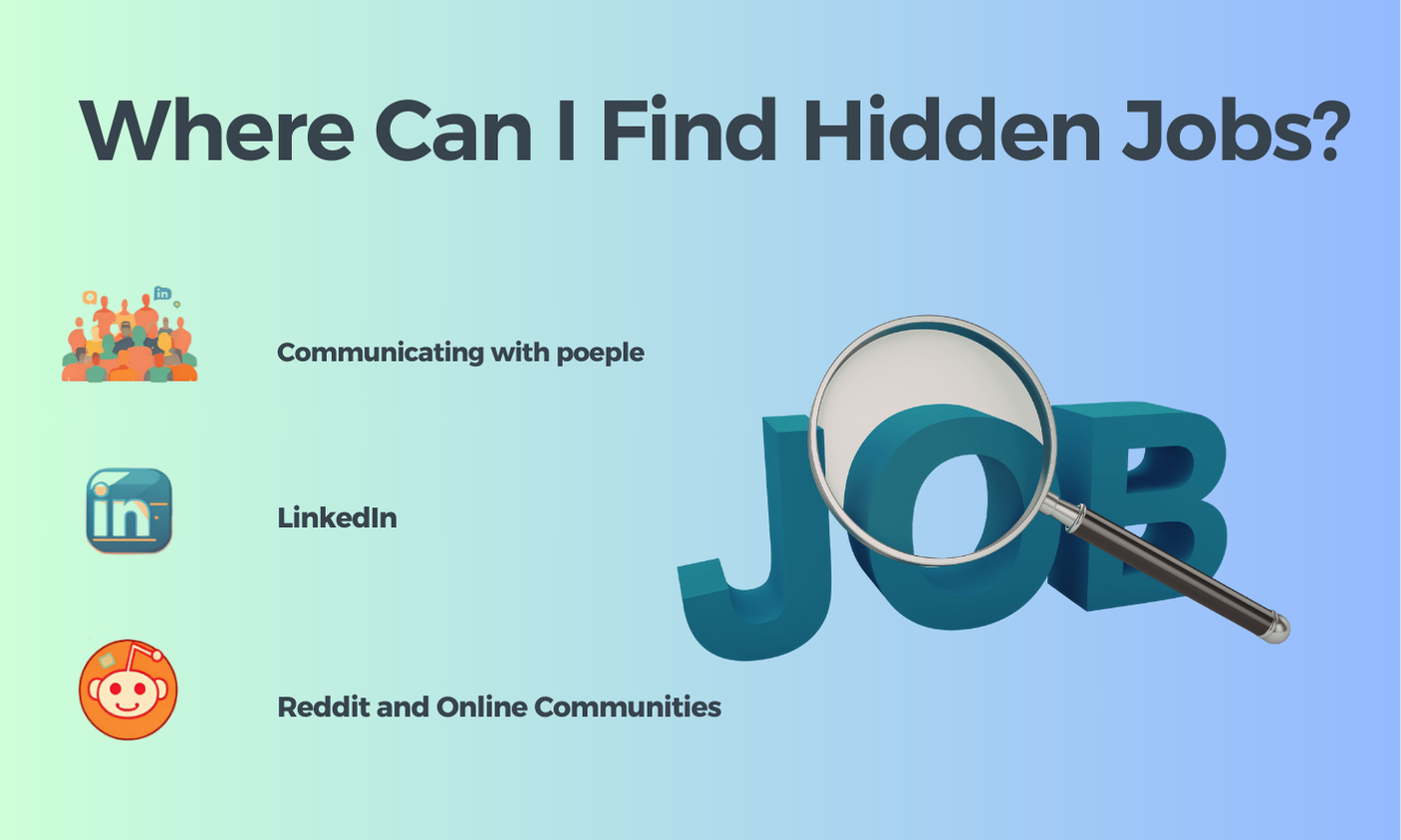
Where Can I Find Hidden Jobs?
You find hidden jobs through people, not online sites or portals. Accessing the Hidden Job Market requires you to shift your focus from submitting a resume or application to building authentic professional relationships.
Your goal is to become a known entity within your target companies and industry circles before a specific need arises.
This means engaging with professionals from different channels, like starting a chat on social media, contributing to industry conversations, and making your value visible to decision-makers.
With this approach, you are sending the correct signals to the employees that you can solve their problems without asking them to hire you.
Hidden Job Market on LinkedIn
LinkedIn is one of the most powerful online tools for accessing the hidden job market. Recruiters and hiring managers constantly use it to search for and engage with potential candidates before a role is posted.
To tap into the hidden job market on LinkedIn,
- Optimize your profile with relevant keywords,
- Showcase your achievements,
- And actively engage with content from leaders in your target companies.
You can also use LinkedIn for thoughtful, warm outreach. Commenting insightfully on a hiring manager's post and then sending a personalized connection request about their insights is far more effective than creating a resume and applying to a job ad.
Hidden Job Market Reddit and Online Communities
Niche online communities are another way to reach hidden job market opportunities. There are many ways on the Platforms like Reddit to reach the professionals who share unposted opportunities, like:
- Specific industry subreddits (e.g., r/forhire, r/cscareerquestions),
- Slack groups,
- Discord servers,
- And specialized forums.
You can engage authentically in these hidden job market Reddit communities by
- Offering help,
- Sharing knowledge,
- And building a reputation
This is the best way to receive direct messages from founders, hiring managers, or employees with leads that never make it to a job board.
It’s the digital equivalent of industry networking.

How to Find the Hidden Job Market (Step-by-Step)
Accessing the Hidden Job Market is a proactive process. Follow this step-by-step approach to move from theory to action and learn how to find hidden job market opportunities.
Step 1: Networking With Intent (Not Asking for Jobs)
The core tactic for how to find hidden job market openings is networking with a mindset of giving, not taking.
Instead of asking new contacts,
"Do you know of any jobs?"
Focus on learning and building relationships by sharing a relevant article or making an introduction.
Your goal is to be helpful, curious, and memorable. In this way, you will be the first person they remember and recommend when a need arises in their network.
Step 2: Working With Recruiters and Referrals
Cultivating relationships with specialized recruiters (headhunters) is a direct line into the hidden job market.
Recruiters are often hired to fill roles confidentially. Make yourself a valuable candidate by:
- Keeping your LinkedIn profile updated
- Communicating your career goals clearly.
Let your network know the specific companies and types of roles you're targeting. A warm introduction from a current employee is the ultimate key that unlocks the door, often bypassing the automated application tracking system (ATS) entirely and landing your resume directly in the hiring manager's hands.
Four Reasons the Hidden Job Market Works Better
There are four compelling reasons why job seekers should embrace the hidden job market:
· Drastically Lower Competition: You might be one of 5 candidates in a conversation instead of one of 500 applicants online.
· Higher Trust Factor: Being referred or sourced directly comes with built-in credibility, easing the employer's perceived risk.
· Better Role Alignment: Roles created or shaped around a conversation are more likely to fit your unique skills and career aspirations.
· Stronger Negotiation Position: Entering as a sought-after candidate, rather than an applicant, gives you more leverage in discussing salary and benefits.
Why the Hidden Market Exists
Reason 1: Hiring is hard
Posting a public job generates 300 applications. Sorting through 300 is painful. Hiring manager's first thought: Is anyone in my network qualified? If yes, problem solved. Don't post publicly.
Reason 2: Referrals are higher quality
Public applications: Mixed quality. Many unqualified. Referrals: Your network knows what good looks like. They only recommend strong people. Companies prefer referrals.
Reason 3: Referral bonuses work
Companies pay referral bonuses (often $5K-$20K) to employees who refer. Employees love money. They refer their good friends. Positions fill through referrals before ever being posted.
Reason 4: It's faster
Public job: 300 applicants, 2-week hiring process. Internal referral: 1-2 candidates, 1-week decision. Companies prefer speed.
The Hidden Market Landscape
Type 1: Pre-posted jobs
The company decided to hire. They're in recruitment but haven't posted publicly yet. They're asking the network: Know anyone? Access: Being in network when they're actively recruiting. Advantage: First-mover advantage. Less competition.
Type 2: Created roles
Company meets amazing candidate. They create role for them. We love you. We didn't have budget for role X. But we want you. We're making it work. Access: Being so strong that company makes role for you. Advantage: Dream role. Higher pay (you're getting offer because they want you).
Type 3: Network expansion jobs
Company has network of people. They refer people to each other. Hey, my friend is looking. You should talk to them. Access: Being part of trusted networks. Advantage: Warm introduction. Trust already exists.
Type 4: Internal referral jobs
Company has opening. They ask employees: Know anyone? Employees refer. Best candidates bubble up. Access: Knowing someone at company who will refer you. Advantage: Referral bonus (your friend gets paid). Company prefer referrals.
Type 5: Recruiter-only jobs
Company contracts recruiters. Recruiters have list of roles to fill. Not public. Access: Building relationships with recruiters. Advantage: Recruiter guides you through process. Advocates for you.
The Hidden Market Job Search Process
Phase 1: Preparation (Month 1)
Define what you want: Role, company type, compensation. Build/refresh your network: Reach out to 10 people. Let them know you're looking. Identify target companies: List 20 companies you'd want to work for. Connect with recruiters: Research 5-10 recruiters in your space.
Phase 2: Activation (Month 2-3)
Informational interviews: Schedule 15-20 conversations. Company research: Follow target companies. Engage with content. Direct outreach: Message people at target companies. Ask for conversations. Recruiter outreach: Contact recruiters. Brief them on what you're looking for.
Phase 3: Opportunities (Month 3-6)
Opportunities will emerge from conversations. People will introduce you. Recruiters will call with roles. When opportunities come: Respond quickly. Take calls. Explore.
Phase 4: Closing (Month 6-8)
Culled list of opportunities. Interview process. Offers. Negotiation.
Key metric: Hidden market usually takes longer initially but closes faster
Public job search: 1-2 weeks to interview, 2-4 weeks to offer. Hidden market: 2-8 weeks to interview (relationship building), 1-2 weeks to offer once you interview.
Combining Public and Hidden Market Strategies
Best approach: Do both
70% of your effort: Hidden market (network, informational interviews, direct outreach). 30% of your effort: Public job boards (keeping options open). Most successful hires come from the hidden market. But public boards don't hurt.
Mixing strategies:
Monday-Wednesday: Network, informational interviews, company research. Thursday-Friday: Apply to public jobs, follow up on recruiter conversations. This balance keeps momentum while staying in the network.
Hidden Job Market vs Public Job Market
|
Aspect |
Hidden Job Market |
Public Job Market |
|
Job Visibility |
Not publicly posted; discovered through networks |
Listed on company websites and major job boards |
|
Competition Level |
Very low (a handful of candidates) |
Extremely high (hundreds of applicants) |
|
Hiring Speed |
Faster, due to pre-existing trust and streamlined processes |
Slower, due to high volume and formal screening steps |
|
Best Access Method |
Proactive networking, referrals, and recruiter partnerships |
Reactive online applications and resume submissions |
|
Candidate Focus |
Fit, potential, and trusted recommendations |
Keywords, resume format, and on-paper qualifications |
Hidden Market Advantages Beyond Job Finding
Advantage 1: Better information
Public posting: Generic description. Network: So the role is X, but really they need someone who can also do Y. The manager is great but the team is understaffed. You get real information.
Advantage 2: Better negotiation
Public job: Offer is what it is. Hidden job: You've already proven value through relationship. You have leverage. You can negotiate.
Advantage 3: Better culture fit
Public job: You're unknown. They're unknown. Hidden job: Mutual evaluation already happened. If it got this far, it's real fit.
Advantage 4: Faster growth
Hidden market positions often come with mentor or ally already in place. That person advocates for you. You grow faster.
Red Flags: When to Use Public Market Instead
Red flag 1: You don't have network in your field
You're just starting. You don't know people. Hidden market won't work yet. Build network first (6-12 months). Then tap hidden market.
Red flag 2: You need a fast hire
You need job in 2 weeks. Hidden market takes longer. Public market may be faster for urgent situations.
Red flag 3: You're in small market
Your field is small. Everyone knows everyone. Hidden market is whole market. Private market might not exist to separate from public.
Red flag 4: You're career-changing
You don't have network in new field. Hidden market won't work. Public market plus networking to build your network.

How Gen Z can fill the gap between the hidden market and online applicants?
Looking for a job in the hidden job market is a big challenge for Gen Z. This generation is exceptionally skilled at navigating job boards and social media, but they have a problem in building the human connections that access the hidden job market, where opportunities are more plentiful and less saturated.
Gen Z prefer to get help from AI to build a professional resume, then submit applications to ATS and wait to receive an online interview request from an employee.
However, the real hiring process often happens through the parallel, relationship-driven hidden job market.
Gen Z usually ignore this fact that hiring is a human process. This focus on the digital application process is a key reason why many of them struggle to find traditional employment within companies and organizations. Faced with this friction, a significant portion of this generation has pivoted towards freelancing, where they can leverage their digital skills and entrepreneurial spirit directly, often with great success.
However, for those who genuinely seek a role within a corporate structure, it is crucial to complement their technical prowess by deliberately cultivating the very human ability to build authentic professional connections and actively engage with the relationship-driven hidden job market.
FAQ About the Hidden Job Market
What is the hidden job market in simple terms?
In simple terms, the hidden job market is all the job openings that get filled through word-of-mouth, employee referrals, recruiters, or direct contact before the company announced for the job position publicly.
How do I access the hidden job market without connections?
Start by building connections from scratch. Use LinkedIn to identify and engage with professionals at your target companies. Attend virtual industry webinars and participate in Q&A. Join relevant professional associations or online communities like specific hidden job market Reddit threads.
Does LinkedIn really help with the hidden job market?
Absolutely. LinkedIn is the best platform for the hidden job market. Recruiters and hiring managers use it daily to source passive candidates.