Have you ever prepared a perfect cover letter, but you don’t know whether to mention your salary expectations? A recent survey found that over 70% of job seekers feel anxious about how and when to discuss compensation. They fear that addressing their expected salary may ruin their chances of getting the jobs. The good news is that there are clear, actionable tactics to handle the salary question in your cover letter professionally and strategically. Let’s learn how to use these tactics to turn a potential pitfall into a negotiation advantage.
Should You Mention Salary in Your Cover Letter?
The decision to mention salary in your cover letter is one of the most critical choices in your application process.
The first rule is:
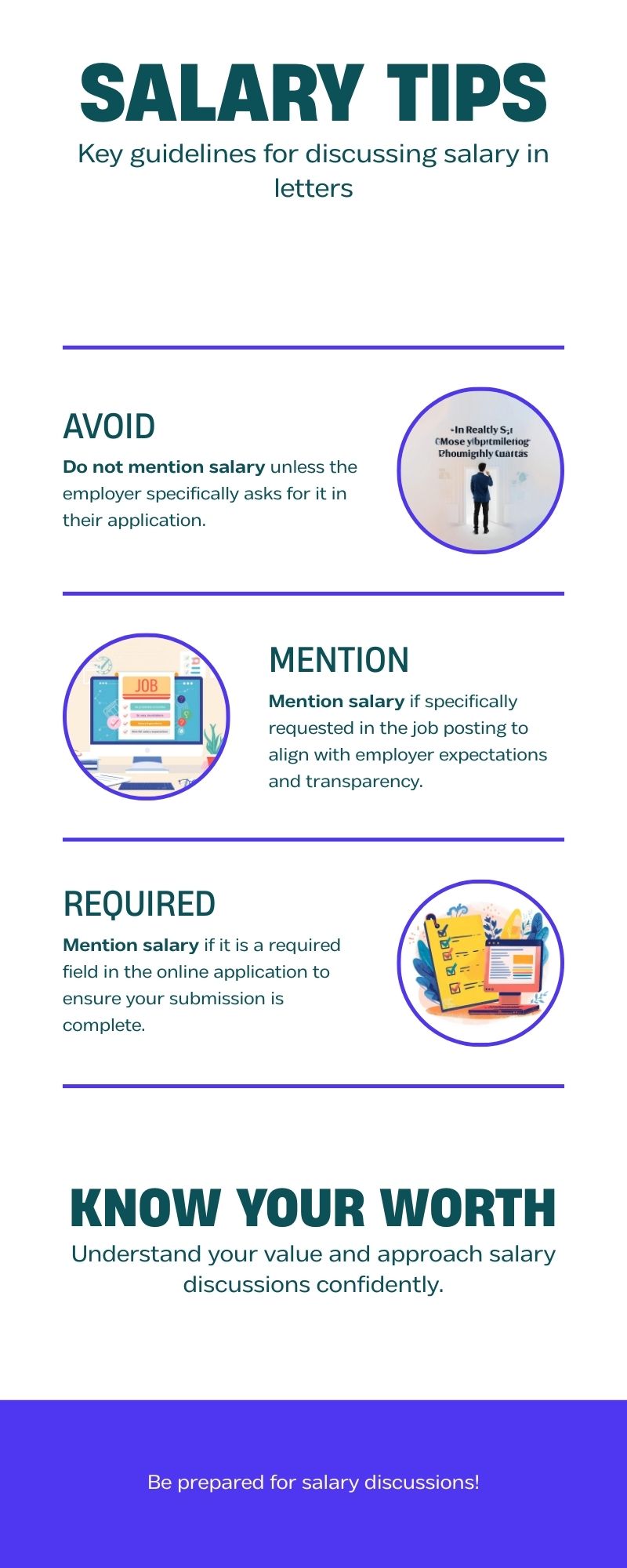
Never volunteer your salary expectations unless the employer explicitly asks for them.
The primary purpose of submitting a cover letter is to sell your skills, experience, and enthusiasm for the role. Addressing the Salary Question too early can shift the focus from your value to a transactional negotiation before you have even secured an interview.
There is a big concern that stating a number that is too high might eliminate you from contention. On the other hand, a number that is too low can undermine your professional worth and limit your future earning potential at the company.
Therefore, as a rule if thumb, it is better to avoid the salary question in your cover letter unless it is directly prompted.
When Employers Expect Salary Information
There are clear situations where you must address the salary question in your cover letter. Let’s review the most common ones:
1. Requested in the job posting
If it is clearly mentioned in the job posting by phrases like:
"Please include your salary requirements with your application."
"Salary expectations must be in your cover letter."
In this situation, you have no choice but to prepare a professional response to addressing the Salary Question in Your Cover Letter.
2. Mandatory field in the online application form
If in an online application portal, there is a mandatory field for salary history or expected compensation.
In these cases, ignoring the request can signal an inability to follow instructions and may result in your application being automatically filtered out.
When You Should Avoid Addressing the Salary Question in Your Cover Letter
You should strategically avoid addressing the salary question in your cover letter when the job posting does not mention compensation.
This is especially important for early-stage applications and for competitive roles where demonstrating your unique value first is prior to stating a number.
Your goal is to convince employees to invite you to the interview, where you can discuss more about your abilities for taking the role's responsibilities, complying with company culture, and addressing salary questions if needed.
Initiating a cover letter salary discussion prematurely can make you seem more interested in the paycheck than the position itself.
“Beyond correcting spelling and grammatical errors, it is essential to evaluate the true value of your content—how your message resonates with hiring professionals and how effectively it convinces them that you deserve the salary you are seeking.”
Jarret Austin, Owner of Bankruptcy Canada
Addressing the Salary Question in Your Cover Letter without Hurting Your Chances
When you are required to address the salary question in your cover letter, the key is to protect your negotiation power and show you are both reasonable and informed.
Tactic #1 Using a Salary Range Instead of a Fixed Number
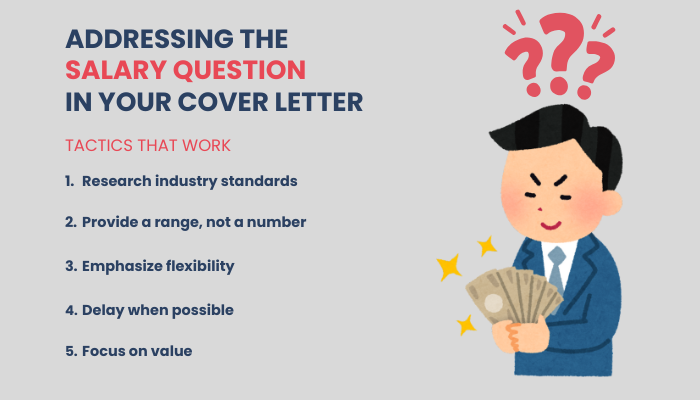
The most effective tactic is to do market research and provide a salary range rather than a single, fixed number. This demonstrates your flexibility and understanding of industry standards.
For example, instead of stating "my salary expectations are $65,000," you might say, "My salary expectations are in the range of $65,000 to $75,000, based on my qualifications and the responsibilities of this role."
The range should be realistic, based on research from sites like Glassdoor, LinkedIn Salary, and industry reports for your location and experience level. A good rule is to keep the spread to about 10-15% from your target number.
Tactic #2 Show Flexibility in Your Wording
Another tactic is to tie your compensation expectations back to the value you bring and remain open to discussion based on the total compensation package, which can include benefits, bonuses, and growth opportunities.
Your phrasing can significantly impact how your salary expectations are received. Use language that shows you are reasonable and focused on the overall opportunity.
The following Phrases are excellent ways to soften the statement:
- "Open to negotiation,"
- "Flexible based on the total compensation package,"
- "Negotiable with my experience and the responsibilities of the role."
This approach in your cover letter indicates that you are a collaborative professional, not just a candidate focused on a single number. It keeps the conversation open for later stages.
How to address the salary question in your cover letter sample?
When addressing salary questions in your cover letter is mandatory that you have to pay attention to placement and tone.
Address it briefly, typically in the closing paragraph of your cover letter, after you have passionately detailed your suitability for the role.
Please keep your response to one to two sentences, and always return to your enthusiasm for the position.
Dos and Don’ts of preparing a professional cover letter
|
Do’s |
Don’ts |
|
Provide a reasonable salary range supported by reliable sources. |
Don’t state a fixed salary number; it can sound demanding and condescending. |
|
Show that you’ve researched industry standards and understand your market value. |
Don’t look unprepared by mentioning a number without justification. |
|
Emphasize the value you bring to the organization and how you contribute to its success. |
Don’t make it transactional by implying “I work, you pay.” |
|
Carefully follow and address any specific salary-related instructions in the job posting. |
Don’t ignore employer requests regarding how salary expectations should be discussed. |
What to write for salary expectations on an application
When you are filling out forms in the Online job applications, the challenges are different from writing a cover letter. In the application forms, you usually have two options: mandatory numeric or text fields.
If the Application Requires a Number
If you are requested to offer an exact salary in the online form and it is not possible to write a text like "negotiable," you must input your target salary based on the realistic midpoint of your researched range.
Ensure the expected salary reflects your minimum acceptable amount plus a buffer for negotiation, as it may be used as a screening benchmark.
If there is room to add text in the Application
If you can add context in the salary expectation field, it is recommended to mention your flexibility and enthusiasm.
For example, in a text box asking:
"What are your salary expectations?"
You have more room to use a strategic phrase like:
"My salary expectations are negotiable regarding the market range for this position, my responsibilities, and the full benefits package. I am targeting a range of approximately [$X] to [$Y]."
Common Mistakes to Avoid When Mentioning Salary
Several mistakes can undermine your application when addressing the salary question in your cover letter.
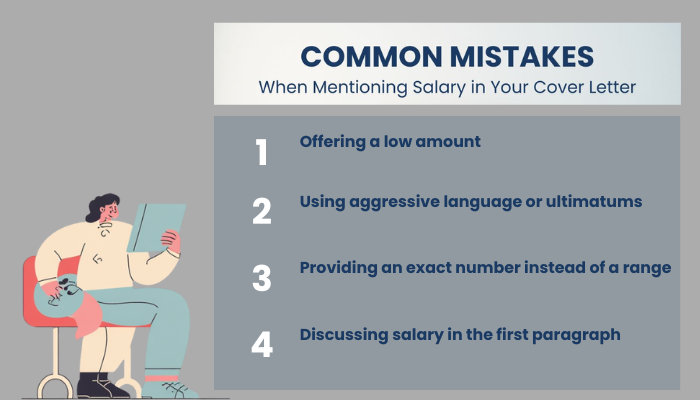
First, offering a low amount means you have underestimated your ability, and employees may think you are inexperienced or desperate.
Second, using aggressive words or an ultimatum (e.g., "I will not accept less than..."). It can immediately disqualify you by showing poor teamwork skills.
Third, providing an exact number instead of a range means there is no room for negotiation.
Finally, discussing salary in the very first paragraph of your cover letter places undue emphasis on compensation before you have established your value.
Salary Expectations Cover Letter Example (General)
Here is a neutral, professional example for a mid-career marketing manager role:
"Regarding my eight years of experience in digital campaign strategy, I am confident that my abilities are perfectly aligned with your needs. As I am eager to work with your team, my expected salary is negotiable. However, I think based on market research and my proven track record of increasing lead generation by over 40%, it is reasonable to consider the range of $85,000 to $95,000. I am, of course, flexible and open to discussing the total compensation package. I am very excited about the opportunity to play a role in [Company Name] and look forward to discussing my qualifications further."
Salary Requirement Letter Sample (Formal Roles)
For more rigid corporate or government roles that require a clear statement, you can use a direct yet polite format:
"As requested in the job posting, my salary requirement is about $72,000 to $80,000 annually. It is essential to mention that my expectation is based on my ten years of experience in regulatory compliance and the industry standard for similar roles in the [City] area. However, I look forward to learn more about the specific responsibilities and the comprehensive benefits offered at [Company Name] so that I can decide about the my salary expectations precisely."
Cover Letter with Salary Requirements for Administrative Assistant
This cover letter with salary requirements for an administrative assistant shows how to tailor the request to a specific role, emphasizing skills and flexibility:
"My five years of experience providing high-level administrative support, including complex calendar management and detailed report preparation, have prepared me well for the Administrative Assistant role at your firm. Based on my research for similar positions in this area, my salary expectations are in the range of $50,000 to $58,000. I am very flexible and eager to discuss how my organizational skills and proactive approach can benefit your team."
Key Takeaways
Successfully addressing the salary question in your cover letter requires a strategic approach. Never volunteer your salary expectations unless explicitly asked. When a request is made, always provide a researched, fair market range instead of a single number to maintain flexibility.
Place this statement briefly in the closing paragraph, after you have thoroughly explained your value. Crucially, use language that shows openness to negotiation and emphasizes your primary interest in the role and the total compensation package.
By following this guide, you can address the requirement professionally without losing the chance for future negotiation.
FAQs of Salary Question in Your Cover Letter
Should I put salary expectations in my cover letter?
Only if the employer explicitly asks for it in the job description or application instructions. If not, it is strategically wiser to defer the conversation.
Is it better to give a range or a fixed number?
We recommend that you always offer a range to show your flexibility and an understanding of the market.
Can I write "negotiable" for salary expectations?
Yes, "negotiable" is an acceptable and common response. It is best paired with a statement about being focused on the right fit and total compensation.
Where should salary expectations appear in a cover letter?
If you must address salary expectations in the cover letter, place a brief statement (1-2 sentences) in the closing paragraph, after you have made a strong statement about your ability and experiences.
How do I answer salary expectations with little experience?
Focus on your skills, education, and enthusiasm. Use phrasing like, "My salary expectations are flexible and aligned with the entry-level market rate for this position in [Location]. I am primarily focused on finding a role where I can grow and contribute."